Turning Lead into Gold: The True Meaning of Spiritual Alchemy
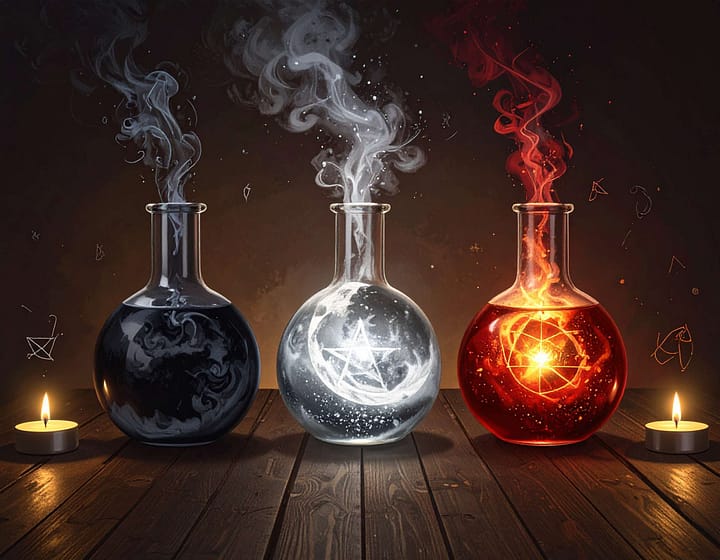
When you hear the word “alchemist,” what comes to mind? A shadowy figure in a medieval laboratory, surrounded by bubbling potions and arcane charts, obsessively trying to turn worthless lead into precious gold. For centuries, this has been the popular image.
But what if the lead wasn’t a metal? And what if the gold wasn’t for spending?
In our last post, we uncovered the Hermetic master key: “As above, so below.” This principle, that the universe and the individual are reflections of each other, is the secret to understanding the true purpose of alchemy. According to Manly P. Hall, the alchemists were not primitive chemists. They were master psychologists and spiritual philosophers. The entire alchemical tradition was a vast and brilliant allegory for the most difficult work of all: the transformation of the human soul.
The Great Work: An Allegory for Your Soul
The alchemists called their sacred art the “Great Work” (Magnum Opus). Hall argues that this work was performed not in a laboratory, but within the soul of the alchemist himself. The strange symbols and cryptic recipes were a coded language designed to describe a process of inner transformation.
- The Base Metals: When an alchemist wrote about turning “base metals” like lead into gold, they were referring to the “base” elements of the unrefined human character. The lead was a symbol for our ignorance, fears, vices, and animalistic passions.
- The Philosophical Gold: The “gold” they sought was not a physical substance, but a spiritual one. It was the symbol of the perfected and regenerated soul: a state of enlightenment and inner peace.
The alchemists used the language of chemistry to hide their spiritual philosophy from the profane and the persecutors of the Inquisition, who would have burned them as heretics.
The Three Principles of Your Being
According to the alchemists, the human being is composed of three essential principles, which they called Salt, Sulphur, and Mercury. The Great Work requires purifying and perfectly balancing these three within oneself.
- Salt: Represents the physical body. It is the principle of stability and form.
- Sulphur: Represents the human soul or spirit. It is the fiery and volatile principle of emotion and desire.
- Mercury: Represents the mind or the mediating soul. It is the fluid, intellectual principle that connects the fiery spirit to the stable body.
An unbalanced person might be ruled by their fiery Sulphur (passions) or weighed down by their earthy Salt (materialism). The goal is to allow the intelligent Mercury (mind) to create a perfect equilibrium.
The Three Stages of Transformation
The Great Work was typically divided into three major stages, a spiritual drama in three acts:
- Nigredo (The Blackening): This is the first and most difficult stage. It represents the dissolution of the profane self. It is a “dark night of the soul,” a period of intense self-examination where the alchemist must consciously confront their own shadow: all their fears and hidden darkness. In the laboratory, this was symbolized by the putrefaction and blackening of the materials. In the soul, it is the painful process of breaking down the ego.
- Albedo (The Whitening): After the blackness of Nigredo comes the dawn. This stage involves purification. It symbolizes the cleansing of the soul from the impurities that were brought to the surface in the first stage. The alchemist, having faced their darkness, now washes it away, emerging into a state of clarity and spiritual awareness.
- Rubedo (The Reddening): This is the final and triumphant stage. It represents the reunion of the purified soul (the “white queen”) with the divine spirit (the “red king”). It signifies the achievement of perfect balance and wholeness. The soul is no longer just pure; it is infused with the fire of divine love and wisdom.
The Philosopher’s Stone: You Are the Treasure
And what is the result of this final, glorious stage? The creation of the legendary Philosopher’s Stone.
Hall is adamant that the Stone is not a physical rock that grants eternal life. The Philosopher’s Stone is the perfected human soul itself. The person who has successfully completed the Great Work becomes the Stone. They have transmuted the lead of their own imperfection into the incorruptible gold of spiritual enlightenment.
This “living Stone” has the power to heal the spiritual sickness of others and to “transmute” the ignorance of those they encounter into wisdom, just by their very presence. They have achieved the ultimate goal of all the Mysteries.
Alchemy, then, is a detailed and profound roadmap for the journey of self-perfection. In our next post, we will explore another, equally rich map of the soul’s ascent: the Kabbalistic Tree of Life.