Philosophy & Spirituality

Beyond Words: Finding God Through Silence in the Hesychast Tradition
March 9, 2026 Mark Tompkins - Author
Hesychasm is a mystical prayer tradition within Eastern Orthodix Christianity that emphasizes the pursuit of inner quietness (heschia) to achieve a direct, conscious experience of God. This contemplative practice, deeply rooted in early Christian monasticism, involves the whole person, body, soul, and mind.

Core Practices and Goals

At the heart of Hesychasm is the continuous repetition of the Jesus Prayer, which typically takes the form: “Lord Jesus Christ, Son of God, have mercy on me, a sinner.” This practice is not merely a verbal recitation but a method to quiet the mind, focus attention, and unite the intellect with the heart.

Practitioners, known as hesychasts, often employ a psychosomatic technique to aid concentration. This method includes:
– Specific Postures: Sitting on a low stool with the head bowed and the chin resting on the chest
– Breath Control: Slowing the rhythm of the breath and sometimes coordinating it with the words of the Jesus Prayer
– Inward Focus: Directing one’s gaze and attention toward the “place of the heart”
The ultimate goal for a hesychast is to attain theosis, or union with God. This spiritual journey is often described in three stages:
1. Katharsis (Purification): A process of purification from passions.
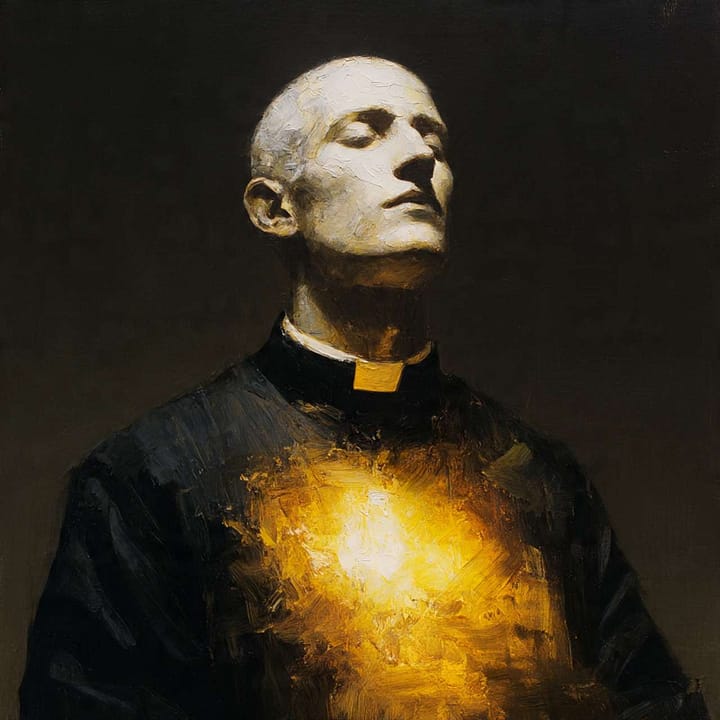
2. Theoria (Illumination): The stage of illumination, where the practitioner may be granted a vision of the “Uncreated Light” of God. This is considered the same divine light that was manifested to the apostles during the Transfiguration of Christ on Mount Tabor.

3. Theosis (Deification): The final stage of union with God, becoming a “partaker of the divine nature.”

Historical Development and the Hesychast Controversy

The roots of Hesychasm trace back to the Desert Fathers in Egypt in the 4th century. However, it took a more definitive form on Mount Athos in the 14th century, leading to a major theological debate known as the Hesychast controversy.

The controversy was initiated by Barlaam the Calabrian, a 14th-century monk who was trained in Western Scholastic theology. He criticized the Hesychasts’ practices, labeling them “navel-gazers” (omphalopsychoi) and arguing that their claims of seeing an “Uncreated Light” were heretical because God is fundamentally unknowable.

St. Gregory Palamas (1296–1359), a monk from Mount Athos, emerged as the primary defender of Hesychasm. He formulated a key theological distinction to explain how direct experience of God was possible:

– Essence vs. Energies: Palamas argued that while God’s inner essence is unknowable and incomprehensible, God reveals Himself through His uncreated energies (or operations). These energies are not God’s essence but are the living God in action, permeating creation.

Therefore, the light the hesychasts experienced was not a created, physical light, but the uncreated divine energies of God Himself. Palamas’s defense was ultimately upheld by a series of councils in Constantinople in the mid-14th century, and his teachings became an established part of Orthodox doctrine.

Key Texts
The teachings and practices of Hesychasm are detailed in the Philokalia, a collection of texts written by spiritual masters between the 4th and 15th centuries. This anthology, first published in Greek in 1782, has been instrumental in the dissemination of Hesychast spirituality, especially in Russia.

Leave a response

Your email address will not be published. Required fields are marked *