Order from Chaos: The Violent, Political World of the Enuma Elish
How was the world created? For the ancient Babylonians, the answer was not a gentle word spoken into a void, but a cosmic war, a political succession, and a gruesome act of creation. This is the story of the Enuma Elish, the great Babylonian creation epic.
The Enuma Elish, meaning “When on high,” is one of the oldest and most important works of Mesopotamian literature. Composed in the second millennium BCE, its primary purpose was to celebrate the rise of Babylon and its patron deity, Marduk, as the supreme power in the universe. It is a story of divine politics, conflict, and creation.
The epic begins not with a single creator, but with a state of primordial chaos personified by two entities: Apsu, the god of fresh water, and Tiamat, the goddess of salt water. From their mingling, a new generation of younger gods is born. These new gods are loud and energetic, and their noise disturbs the slumber of Apsu, who plots to destroy them.
This leads to the first divine war. The younger gods, led by the clever Ea, defeat and kill Apsu. Enraged by the death of her consort, the formidable Tiamat vows revenge. She creates an army of monstrous demons and elevates her new general, Kingu, to lead them, bestowing upon him the Tablet of Destinies, a symbol of supreme authority.
The younger gods are terrified of Tiamat’s wrath. One by one, they refuse to face her, until a new champion emerges: the young, powerful storm god Marduk, son of Ea. Marduk agrees to fight Tiamat, but only on one condition: if he is victorious, he will be granted absolute sovereignty over all the gods. They agree.
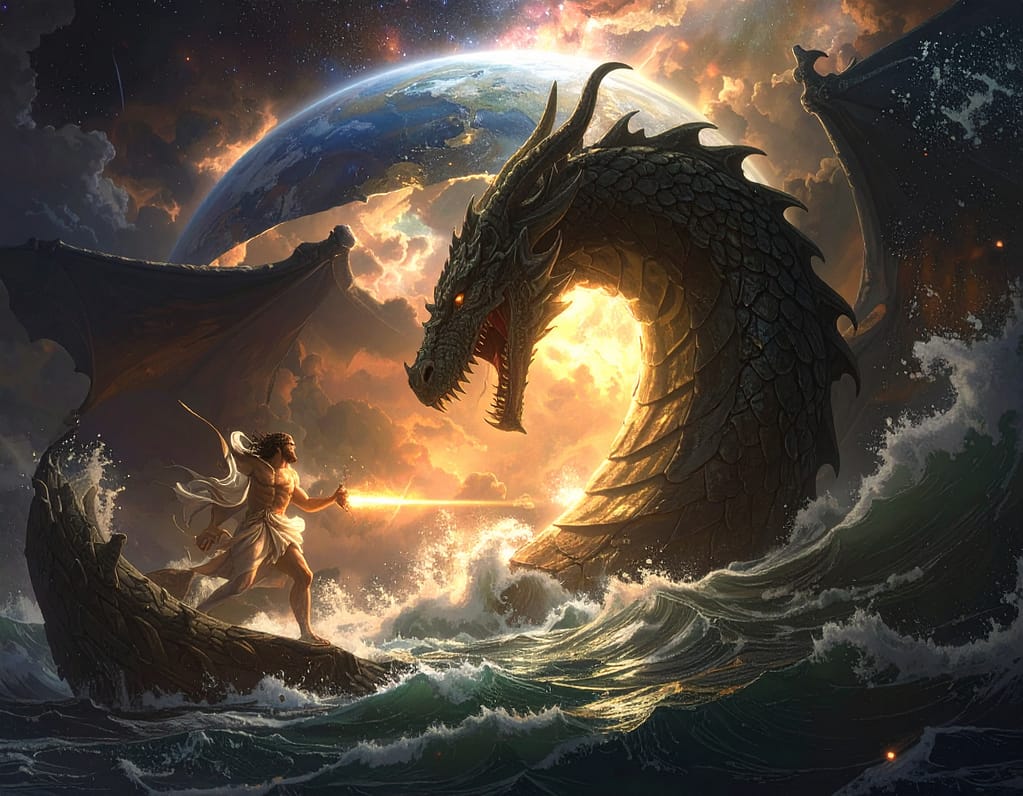
The climax of the epic is the savage battle between Marduk and Tiamat, often depicted as a cosmic dragon. Armed with winds, a net, and his bow, Marduk challenges and slays the chaos monster. This victory is the pivotal moment of creation. Marduk splits Tiamat’s corpse in two, using one half to form the arch of the heavens and the other to create the earth. He establishes the constellations, organizes the calendar, and fixes the courses of the stars and planets.
But the work is not done. The gods still need beings to perform the drudgery of maintaining the cosmos. To solve this, Marduk executes Tiamat’s general, Kingu, and from Kingu’s blood, mingled with earth, he creates the first human beings. The purpose of humanity, in the Babylonian worldview, was explicit: to be the servants and laborers of the gods, freeing them to live in leisure.
The Enuma Elish is more than a myth; it is a foundational text that reveals the Babylonian worldview. It establishes that order is not a given state, but a victory won through violent conflict. It justifies the political supremacy of Babylon by mirroring it in the divine realm with Marduk’s kingship. Finally, it presents a stark vision of humanity’s place in the cosmos, not as partners or children of the divine, but as slaves created to serve. It remains a powerful, dramatic, and unsettling look into the ancient mind.
What does it say about a culture when its creation story is based on war, and its view of humanity is one of servitude? Let me know your thoughts in the comments.