More Than a Triangle: The Sacred Mathematics of Pythagoras
If you remember one thing from high school geometry, it is probably the Pythagorean theorem. We know Pythagoras as the man of triangles and numbers, the ancient father of mathematics. But for Manly P. Hall, that picture is a faint shadow of who he really was.
Last time we looked at the initiation rites of the Egyptian Mysteries. Out of those same schools, Hall argues, came a brilliant young student who had absorbed their deepest teachings. That student was Pythagoras. He was a master initiate, and the mathematics was the smallest part of him.
Today we look past the textbook image to the hidden philosophy of Pythagoras, a man who believed the universe was a divine symphony and that mathematics was the key to hearing its song.
The School at Crotona: A New Mystery
After traveling the ancient world and taking initiation into the secret doctrines of Egypt and Babylon, Pythagoras settled in Crotona, a Greek colony in southern Italy. There he founded a school of his own, a Mystery School built on the model of the ones that had trained him.
His disciples lived under strict rules of conduct and a vow of silence. The school existed to lead the soul toward spiritual rebirth. Producing mathematicians was beside the point. His instruments were numbers, geometry, and music.
The Secret of “All is Number”
The most famous Pythagorean doctrine holds that all things are number. Hall warns against reading this as a dry fact of arithmetic. For Pythagoras, numbers did far more than count. They were living symbols, the divine principles behind the architecture of creation.
- The number 1, the Monad, stood for the unmanifest God, the origin of all things.
- The number 2, the Duad, marked the splitting of the One into opposites, light and dark, good and evil.
- The number 10, the Decad, was the most sacred of all, since it gathered the first four numbers (1+2+3+4=10) and stood for the close of a cosmic cycle.
To the Pythagoreans the whole universe, from the orbits of the planets to the opening of a flower, was the work of these sacred numbers. To study mathematics was to study the mind of God.
Sacred Geometry: The Blueprint of the Cosmos
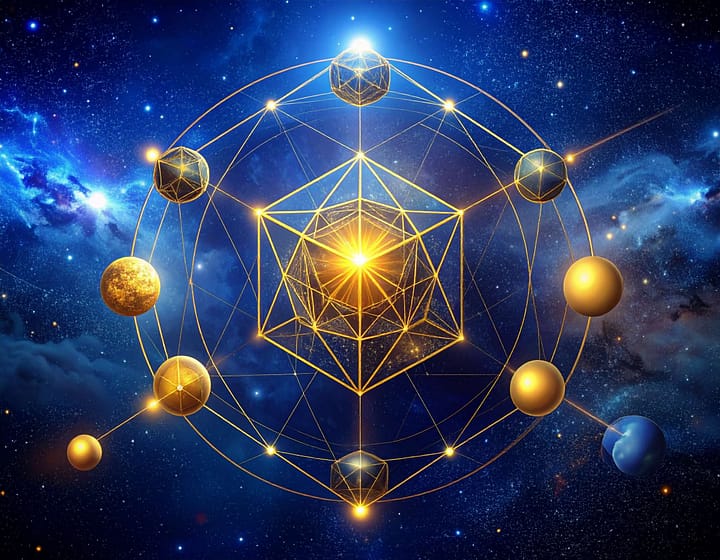
Numbers were the principles; geometry made them visible. Pythagoras taught that geometric shapes were the real building blocks of the universe, not abstractions on a page. He matched the five perfect solids, for instance, to the classical elements of earth, water, air, fire, and the celestial ether.
By dwelling on these clean, balanced forms, a student could bring his own soul into the same order. The Pythagoreans held that a life surrounded by symmetry and beauty would shape a noble mind and a steady character. Geometry became a kind of meditation, a way to bring the inner world into line with the blueprint of the cosmos.
Hearing the Music of the Spheres
This brings us to the loveliest of all the Pythagorean ideas: the music of the spheres.
Pythagoras taught that as the planets and stars wheeled through the heavens, their exact orbits gave off a constant music, a divine symphony. We cannot hear it, though not for any faintness in the sound. It has surrounded us since birth, and we have learned to tune it out. Our souls, lost in the noise of material life, have gone deaf to the song of the universe.
The Pythagorean initiate set out to cleanse his own soul until he could hear that cosmic music again. A life of virtue and contemplation, joined to the study of harmony, could tune the inner self to the symphony of the spheres. Pythagoras himself was said to have reached that state, and he used music as medicine in his school, cleansing his students’ souls and drawing them back into tune with the universal harmony.
For Pythagoras, mathematics and music were sacred tools aimed at the one purpose behind every Mystery School: bringing the human soul into conscious alignment with the divine.
From the bright, ordered cosmos of Pythagoras, the series turns next to a wholly different vision, a worldview that saw the material world as a flawed prison for a fallen spark of the divine, rather than a symphony of the spheres. Next time we step into the strange world of the Gnostics.