Before the Pyramids – Part 1: Reading the Stones: Physical Evidence of Egypt’s First Rulers
I. OPENING: The Scene
Stand in the desert at Abydos, about 300 miles south of Cairo, and you’re standing on one of the most important archaeological sites in the world. Here, in a place the ancient Egyptians called Umm el-Qa’ab (Mother of Pots), lie the tombs of Egypt’s earliest kings.[1] The desert sun beats down on mud-brick walls that have stood for five thousand years. Shards of pottery litter the sand, representing broken pieces of vessels that were left by ancient pilgrims who came to honor the first rulers of a unified Egypt.
Everything we know about who these rulers were, when they lived, and what they accomplished, comes from fragments. We have pieces of stone carved with images, bits of pottery stamped with royal names, and tomb chambers that were looted in antiquity but still hold clues. There are no documents from this period explaining who became king when, or how Egypt was unified. There are no histories written by people who witnessed these events. We have objects, and from these objects, we must reconstruct the birth of one of history’s greatest civilizations.
II. THE PROBLEM STATED
We’re trying to identify specific individuals who lived more than five thousand years ago. The period we’re examining, roughly 3200 to 3000 BCE, is called the Early Dynastic Period or Dynasty 0, which represents the transition from prehistoric Egypt to the historical pharaonic state.[2] Writing was just being invented during this time. What little documentation exists consists of labels, seals, and ceremonial inscriptions, not narrative accounts that tell us what happened.
No continuous written records survive from this time. The famous Egyptian king lists, which were carved on temple walls or written on papyrus, were created two thousand years or more after these earliest rulers died.[3] They’re valuable sources, but they’re also distant from the events they describe, having been filtered through centuries of oral tradition, religious reinterpretation, and political agenda.
What we have instead are objects. We find a ceremonial palette here, a tomb chamber there, and fragments of pottery bearing royal symbols scattered across archaeological sites. We also have stone vessels, ivory labels, and other artifacts. These items don’t speak clearly or unambiguously. They require interpretation, and interpretation involves educated guesswork. So what exactly do we have to work with?
III. THE NARMER PALETTE: Our Clearest Evidence
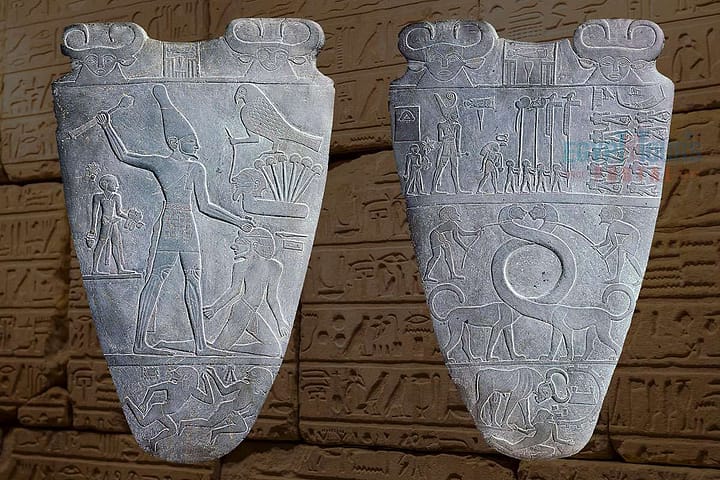
The single most important artifact for understanding Egypt’s first rulers is a piece of carved siltstone about 25 inches tall, which is shaped like the cosmetic grinding palettes Egyptians used to prepare eye makeup. It was discovered in 1898 by British archaeologist James Quibell at Hierakonpolis, an important predynastic site in Upper Egypt.[4] Today it resides in the Egyptian Museum in Cairo.
This is the Narmer Palette, and it depicts a king named Narmer performing acts of conquest and unification.
On one side, Narmer wears the white crown of Upper Egypt, which is the tall, bowling-pin-shaped hedjet. He’s shown in the traditional smiting pose, holding a mace raised above his head while gripping a kneeling captive by the hair. Above the captive, a falcon representing the god Horus perches on papyrus plants, holding a rope that’s attached to another captive’s nose. Below Narmer’s feet, two naked enemies lie dead or dying. A sandal-bearer walks behind the king, and hieroglyphic symbols identify Narmer by name.
On the reverse side, Narmer wears the red crown of Lower Egypt, which is the flat-topped deshret with its distinctive curl. He’s shown in a procession with standard-bearers, walking to inspect the beheaded corpses of enemies that are laid out in rows with their heads placed between their feet. In the center of this side, two mythical animals with serpentine necks are intertwined, and their circle possibly represents the unification of the Two Lands. At the bottom, a bull, which is another symbol of royal power, breaks through the walls of a fortified city.[5]
The symbolism seems clear. Narmer, wearing both the crown of Upper Egypt and the crown of Lower Egypt, has unified the two regions through military conquest. This is our strongest piece of evidence for who unified Egypt and when. Based on pottery styles and other archaeological context from Hierakonpolis, scholars date the palette to approximately 3100 BCE.[6]
But questions remain even with this remarkable artifact. Is the Narmer Palette depicting actual historical events, or is it royal propaganda designed to project an image of power? Does wearing both crowns mean Narmer personally unified Egypt, or could he be commemorating a unification that happened earlier, perhaps begun by his predecessors? Ceremonial objects often celebrate ideals rather than facts. The palette tells us Narmer was important and connected to unification, but it doesn’t give us a complete narrative of what actually happened.
IV. WORKING BACKWARDS: Earlier Kings
If we had only the Narmer Palette, the story would be simple. Narmer unified Egypt around 3100 BCE and became the first pharaoh. But archaeology has revealed evidence of earlier rulers, kings whose names appear on pottery, seals, and tomb goods, which pushes the timeline of Egyptian kingship back further and complicates our understanding.
These earlier kings are identified by their serekhs, which is a distinctive Egyptian symbol showing the king’s name inside a rectangular frame that represents a palace facade, topped by a falcon representing the god Horus. The serekh was the standard way of writing a royal name in the earliest periods of Egyptian history.[7]
Three kings before Narmer have serekhs that were found at Abydos. Their names are Iry-Hor, Ka, and Scorpion.
Iry-Hor’s name appears on pottery vessels that were found in tombs at Abydos and at other sites.[8] Some scholars believe Iry-Hor ruled only Upper Egypt, which would make him a regional king rather than a pharaoh of unified Egypt. Others argue he was Narmer’s predecessor, perhaps his father, and may have begun the process of bringing Upper and Lower Egypt together.
Ka’s name similarly appears on stone vessels and pottery that have been excavated from this period. His relationship to Iry-Hor and to Narmer is uncertain. The sequence of these early rulers isn’t entirely clear from the archaeological record. We have their names preserved in the artifacts, but we don’t have definitive information about the order in which they ruled or how long their reigns lasted.[9]
Scorpion, who may actually represent two different kings known as Scorpion I and Scorpion II, presents an even more intriguing case. The name appears on multiple artifacts, including a ceremonial mace head found at Hierakonpolis.[10] This mace head shows a king wearing the white crown of Upper Egypt and holding a hoe or mattock, apparently performing a ceremonial irrigation or canal-opening ritual. Officials and standard-bearers surround him in the scene. The imagery suggests organized state power, agricultural management, and ritual authority.
Most remarkably, there’s Tomb U-j at Abydos, which represents one of the most significant discoveries for understanding early Egyptian kingship.
Tomb U-j is a large tomb structure dating to approximately 3200 BCE, which is roughly a century before the Narmer Palette. It’s believed to belong to Scorpion I, though this identification isn’t certain.[11] The tomb originally contained hundreds of wine jars, many of which were imported from the southern Levant in what is now modern-day Israel and Palestine. This indicates extensive trade networks existed at this early date. More significantly, the tomb contained small bone and ivory labels with what appear to be the earliest hieroglyphic inscriptions yet discovered in Egypt.
These labels aren’t fully developed hieroglyphic writing as we know it from later periods, but they’re clearly more than simple pictures. They show combinations of symbols that appear to record information, possibly inventory lists or descriptions of the tomb contents’ origins.[12] This proto-writing system wasn’t developing in a vacuum. In Mesopotamia, Sumerian cuneiform had begun emerging around 3400 to 3200 BCE, similarly starting as administrative record-keeping before evolving into full written language.[13] Whether Egyptian hieroglyphics developed independently or were inspired by contact with Mesopotamian writing systems remains debated among scholars. The imported goods in Tomb U-j demonstrate that trade networks existed that could have transmitted ideas, if not the writing systems themselves, between these regions.[14]
What the Tomb U-j labels tell us is that by 3200 BCE, a century before Narmer, someone in Egypt had the authority and resources to command long-distance trade, to be buried in an elaborate tomb, and to use a proto-writing system for administrative record-keeping. This pushes our understanding of organized Egyptian kingship significantly earlier than the traditional narrative suggests.
Each discovery like this pushes our understanding of Egyptian kingship earlier in time. The pattern that emerges is one of increasing complexity and organization over time, with multiple generations of rulers gradually building the foundations of what would become pharaonic Egypt.
V. THE PHYSICAL EVIDENCE OF UNIFICATION
Beyond the evidence for individual rulers, archaeologists look for broader patterns in material culture that might indicate when and how Egypt unified. The unification of Upper and Lower Egypt wasn’t just a political event. It would have involved the integration of two distinct regional cultures, each with its own pottery styles, burial customs, architectural traditions, and likely dialects or languages.
One of the clearest signs of unification appears in pottery styles and distribution. Before approximately 3100 BCE, Upper Egyptian pottery shows distinctive characteristics that include red polished wares, black-topped vessels, and decorative styles typical of what archaeologists call the Naqada culture. Lower Egyptian pottery from the Delta region had different forms and decoration that were distinct from the southern styles. Around the time of Narmer, Upper Egyptian pottery styles begin appearing at Lower Egyptian sites.[15] This suggests either increased trade, migration of populations, or political control extending northward from Upper Egypt.
Architectural styles also show evidence of cultural integration during this period. The style of tomb construction that was characteristic of Upper Egypt begins appearing in the north. Mud-brick construction techniques spread from one region to the other. The serekh symbol itself, with its distinctive palace facade pattern, becomes standardized across both regions.[16]
Administrative artifacts provide perhaps the most concrete evidence of centralized control extending across both regions. Clay seal impressions bearing royal names appear at sites throughout both Upper and Lower Egypt. These seals would have been used to secure containers of goods, mark official correspondence, or authenticate documents. Their widespread distribution suggests a bureaucratic system that extended the king’s authority across a unified territory. Wine jar labels and other inventory markers show a system of taxation or tribute, with goods flowing from various regions to central storage facilities that were controlled by the king.[17]
Cylinder seals, which are a technology borrowed from Mesopotamia, appear in Egypt during this period. These small carved stone cylinders could be rolled across clay to create an impression, serving as a kind of signature or official stamp. Their adoption in Egypt coincides with the development of more complex administrative systems, which suggests the need for new tools to manage an expanding state.[18]
However, not all evidence points to peaceful integration of the two regions. Some sites from this period show signs of destruction. Fortification walls were built and sometimes burned. The Narmer Palette itself depicts military conquest and dead enemies, which suggests violence played a role in unification. Whether unification happened primarily through military force, political marriage and alliance, economic integration, or some combination of these methods remains unclear. The physical evidence allows for multiple interpretations of how the process actually unfolded.[19]
VI. WHAT THE STONES CAN’T TELL US
Despite these remarkable artifacts, enormous gaps remain in our knowledge of this period. The archaeological record is fragmentary by nature. Organic materials like papyrus, wood, and cloth rarely survive five thousand years in most conditions, though Egypt’s dry climate preserves more than most places in the world. What we have represents only what was durable enough to last and fortunate enough to escape destruction over the millennia.
Many of the royal tombs at Abydos were looted in antiquity, some possibly as early as the Old Kingdom, which was only a few centuries after they were built.[20] Tomb robbers took valuable goods and often disturbed or destroyed everything else in the process. Later building projects sometimes reused stones from earlier structures, further scattering the evidence. Natural processes like wind erosion and occasional flooding took their toll over the centuries. What archaeologists find today represents a tiny fraction of what originally existed.
The artifacts we do have often lack clear context that would help us interpret them more accurately. The Narmer Palette, for instance, was found in a deposit at Hierakonpolis along with other ceremonial objects, apparently deliberately buried in antiquity. But we don’t know why these objects were buried or when exactly this happened. The circumstances of deposition affect how we interpret the objects, but those circumstances aren’t always clear from the archaeological record.[21]
Dating presents its own set of challenges for understanding this period. Archaeologists use several methods to date artifacts from this era, including pottery typology, which involves comparing styles that changed over time, stratigraphy, which means analyzing layers of soil and debris, and increasingly, radiocarbon dating of organic materials found with the artifacts. Each method has limitations and margins of error that affect our conclusions. Radiocarbon dates from this period typically have uncertainty ranges of plus or minus 50 to 100 years or more.[22] That’s a significant span of time when we’re trying to determine whether one king preceded another or whether events were separated by decades or generations.
The objects themselves don’t always clearly identify their owners or makers, which creates additional ambiguity. A pot with a royal seal might have been made during that king’s reign, or it might have been an heirloom that was kept for generations before being placed in a tomb. A tomb might belong to the person whose name appears on objects inside it, or those objects might have been gifts, loot taken from enemies, or reused items from earlier burials.
Perhaps most significantly, we’re interpreting symbols and images that were created by a culture very different from our own. When we see Narmer wearing both crowns, we interpret this as symbolizing unification of the two regions. But are we reading the symbolism correctly? Could it mean something else entirely to the ancient Egyptians who created and viewed these images? The people who created these objects aren’t here to explain their intentions or the cultural context that would help us understand them. We bring our own assumptions and cultural frameworks to the interpretation, and those might not match ancient Egyptian thinking at all.
VII. CLOSING: The Foundation for Debate
What we have from Egypt’s earliest dynasties is remarkable by any standard. We have ceremonial palettes showing kings in triumph, tombs containing the burials of rulers, pottery and seals bearing royal names, evidence of trade networks and administrative systems, and the very beginnings of written language. These artifacts demonstrate that by 3200 to 3000 BCE, sophisticated political organization existed in Egypt, with rulers commanding resources, projecting power, and creating lasting monuments.
The Narmer Palette gives us a clear image of a king who was associated with unification around 3100 BCE. Tomb U-j and the artifacts of kings like Scorpion, Ka, and Iry-Hor push the timeline of Egyptian kingship back at least a century earlier, revealing a longer and more complex process of state formation than we might expect from later Egyptian traditions.
But these physical objects also raise more questions than they answer. Who exactly were these early rulers? What was the relationship between them? Did they rule sequentially, or were some of them contemporaries ruling different regions? How long did each reign last? What was the actual nature of their authority? How did unification actually happen on the ground?
The stones can tell us only so much about these questions. To answer these deeper questions, we need to look at how scholars have interpreted this evidence and the competing theories they’ve developed over decades of study. With this archaeological foundation established, we can now examine the vigorous debates about whether Narmer was truly the first pharaoh, whether he might be the same person as the legendary Menes, or whether someone else entirely deserves that title.
REFERENCES
[1] O’Connor, David. Abydos: Egypt’s First Pharaohs and the Cult of Osiris. Thames & Hudson, 2009.
[2] Wilkinson, Toby A.H. Early Dynastic Egypt. Routledge, 1999.
[3] Redford, Donald B. Pharaonic King-Lists, Annals and Day-Books: A Contribution to the Study of the Egyptian Sense of History. Benben Publications, 1986.
[4] Quibell, J.E. Hierakonpolis, Part I. Bernard Quaritch, 1900.
[5] Baines, John. “The Narmer Palette: Formal Structure and Meaning.” Nekhen News 15 (2003): 22-23.
[6] Wilkinson, Toby A.H. “What a King Is This: Narmer and the Concept of the Ruler.” Journal of Egyptian Archaeology 86 (2000): 23-32.
[7] Kahl, Jochem. “Hieroglyphic Writing During the Fourth Millennium BC: an analysis of systems.” Archéo-Nil 11 (2001): 103-134.
[8] Dreyer, Günter. “Recent Discoveries at Abydos Cemetery U.” In The Nile Delta in Transition: 4th to 3rd Millennium BC, edited by Edwin C.M. van den Brink, 293-299. Tel Aviv, 1992.
[9] Wilkinson, Toby A.H. Early Dynastic Egypt. Routledge, 1999, pp. 67-71.
[10] Quibell, J.E., and F.W. Green. Hierakonpolis, Part II. Bernard Quaritch, 1902.
[11] Dreyer, Günter. “Umm el-Qaab: Nachuntersuchungen im frühzeitlichen Königsfriedhof, 9./10. Vorbericht.” Mitteilungen des Deutschen Archäologischen Instituts, Abteilung Kairo 54 (1998): 77-167.
[12] Dreyer, Günter, et al. “Umm el-Qaab: Nachuntersuchungen im frühzeitlichen Königsfriedhof.” Mitteilungen des Deutschen Archäologischen Instituts, Abteilung Kairo 49 (1993): 23-62.
[13] Nissen, Hans J., Peter Damerow, and Robert K. Englund. Archaic Bookkeeping: Early Writing and Techniques of Economic Administration in the Ancient Near East. University of Chicago Press, 1993.
[14] Hartung, Ulrich. “Imported Jars from Cemetery U at Abydos and the Relations between Egypt and Canaan in Predynastic Times.” In Egypt and the Levant: Interrelations from the 4th through the Early 3rd Millennium BCE, edited by Edwin C.M. van den Brink and Thomas E. Levy, 437-449. Leicester University Press, 2002.
[15] Köhler, E. Christiana. “The State of Research on Late Predynastic Egypt: New Evidence for the Development of the Pharaonic State?” Göttinger Miszellen 147 (1995): 79-92.
[16] Spencer, A. Jeffrey. Early Egypt: The Rise of Civilisation in the Nile Valley. British Museum Press, 1993.
[17] Regulski, Ilona. “The Origin of Writing in Relation to the Emergence of the Egyptian State.” In Before the Pyramids, edited by Emily Teeter, 149-154. Oriental Institute Museum Publications, 2011.
[18] Pittman, Holly. “Mesopotamian Intraregional Relations Reflected through Glyptic Evidence in the Late Chalcolithic 1-5 Periods.” In Artefacts of Complexity, edited by T.C. Potts, 403-443. Oxbow Books, 1993.
[19] Savage, Stephen H. “Descent into Egypt: Toward an Archaeology of the Southern Levantine Contribution to Early Egyptian State Formation.” In Egypt and the Levant, edited by Edwin C.M. van den Brink and Thomas E. Levy, 463-477. Leicester University Press, 2002.
[20] O’Connor, Abydos, 2009, pp. 27-31.
[21] Adams, Barbara. “The Fort Cemetery at Hierakonpolis.” In Followers of Horus, edited by Renée Friedman and Barbara Adams, 155-186. Oxbow Books, 1992.
[22] Dee, Michael, et al. “An absolute chronology for early Egypt using radiocarbon dating and Bayesian statistical modelling.” Proceedings of the Royal Society A 469 (2013): 20130395.